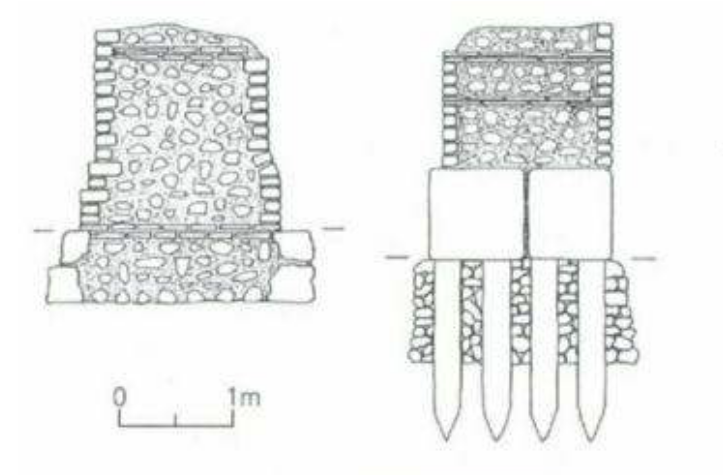
Due to a number of excavation campaigns throughout the 20th century, it is known that the defensive fortifications of the castellum consisted of 12 wall parts surrounding an approximate area of 1.5 hectares. In particular, a 1983 excavation led by Titus Panhuysen of an 8-meter section of western rampart wall provides us with the most comprehensive overview for the wall dimensions and construction techniques (Panhuysen, 1984). This and other excavations that include smaller sections of the wall remains firmly establish a maximum width of two meters. However, the rampart wall height requires estimation since no wall parts are preserved to their full height. It is therefore estimated that the walls reached a maximum of 6 meters as a height of less than 4 meters does not provide sufficient protection while a height above 6 meters is not structurally sound (Wetzels, 2017). The foundation trenches of the walls are at least one meter deep and consist of mainly limestone fragments and rubble, with the west and south walls showing evidence of wooden foundation piles as extra support to accommodate the looser soil near the Meuse and Jeker rivers (Panhuysen, 1996; 2006).
In terms of construction, the walls followed a typical 4th century construction technique of opus vittatum — single visible layers of small local stone blocks encasing an inner core of concrete mortar and debris. For the Maastricht castellum, the mini blocks were constructed in large and small sizes with a general measurement of 24Lx10Hx15W cm for the large blocks and 8Lx8Hx15W cm for the small ones. The sandstone material is geologically dated to the Devonian period, with a possible provenance of the Belgian Ardennes. The inner and outer wall faces were not exact mirrors of each other. The field-facing wall was slanted to accommodate a slightly wider base near the foundation, while the city-facing wall instead had a stepped profile (see image below).