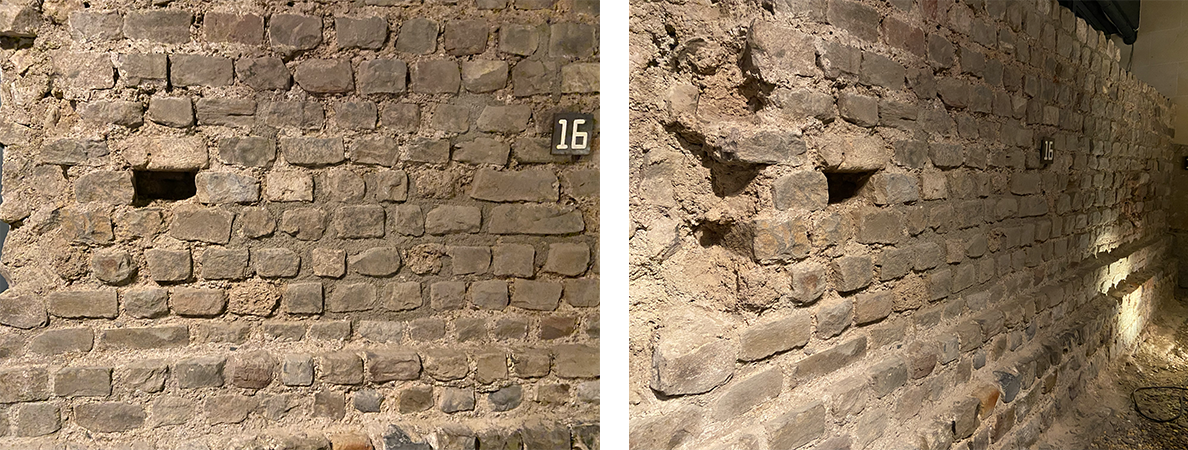
Seamless, image-based texture materials were applied to bring the scene closer to its likely appearance. Many of these textures were drawn from free, open-license online texture libraries and adjusted to approximate the site’s building materials. For example, the castellum wall masonry colours, surface character and patterns were based on published illustrations found in Panhuysen (1996) as well as photographs taken of the visible wall remains in the basement of the Derlon Hotel. A small number of 3D assets, such as the 2nd cent. gravestones reused in the 4th cent. bridge renovation, were taken from open‑licensed models on Sketchfab – a popular 3D marketplace.
Within Blender, the interpretation process also made use of digitised research sources that were incorporated directly into the 3D environment. This began with the archaeological site plan, which was used to establish the footprint of the castellum, the alignment of its walls and towers and the position of the gates and internal structures. Cross-sections from published excavation reports guided the heights and proportions of individual elements. Where evidence was missing, comparisons were made with contemporary sites in the region to model plausible forms.