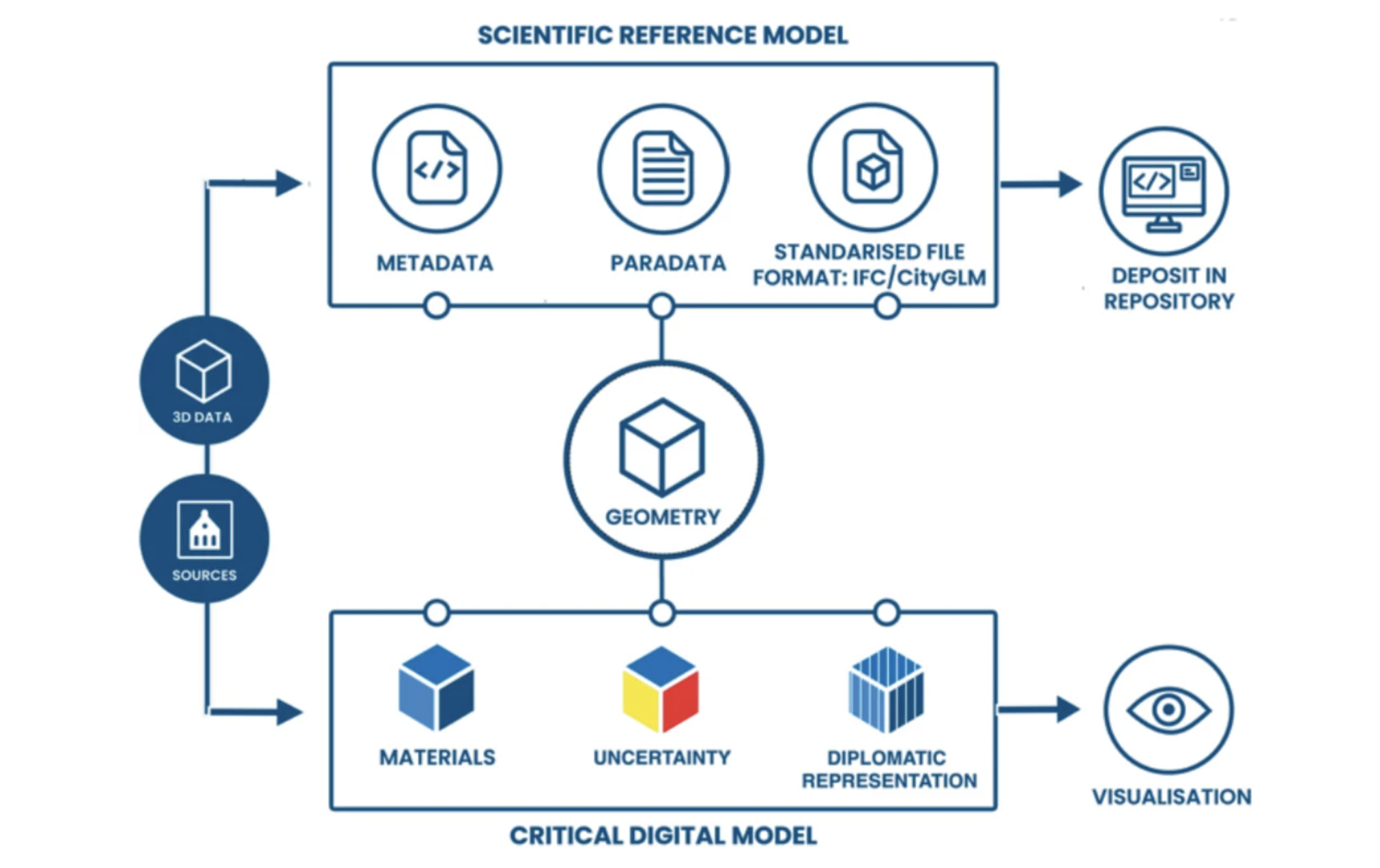
Source-based hypothetical reconstructions of archaeological heritage typically begin with site maps, drawings and excavation reports of the physical evidence of a particular site: the archaeological remains of walls, ditches, roads and more. Because these remains are often fragmentary, adapted or completely missing due to development and progress, the hypothetical reconstruction also draws on historical illustrations, prior reconstructions and regional site comparisons. These varied sources are interpreted, compared and weighed against one another in order to arrive at one or more plausible architectural scheme (Demetrescu, 2018; Münster, 2022; Münster et al., 2024).
Artistic skill and judgement also play a significant role. Decisions about roof forms, window and door openings or surface treatments are guided by regional building practices but ultimately required informed intuition and aesthetic choices (Favro, 2006). Despite these imaginative creative liberties, the 3D model operates like many other forms of scientific inquiry (Watterson, 2015; Apollonio, 2024). As a structured investigation, historians, archaeologists, architectures work together with 3D artists to pose questions, evaluate evidence, propose and test hypotheses and then communicate the results and reasoning process to specialists and the wider public alike.