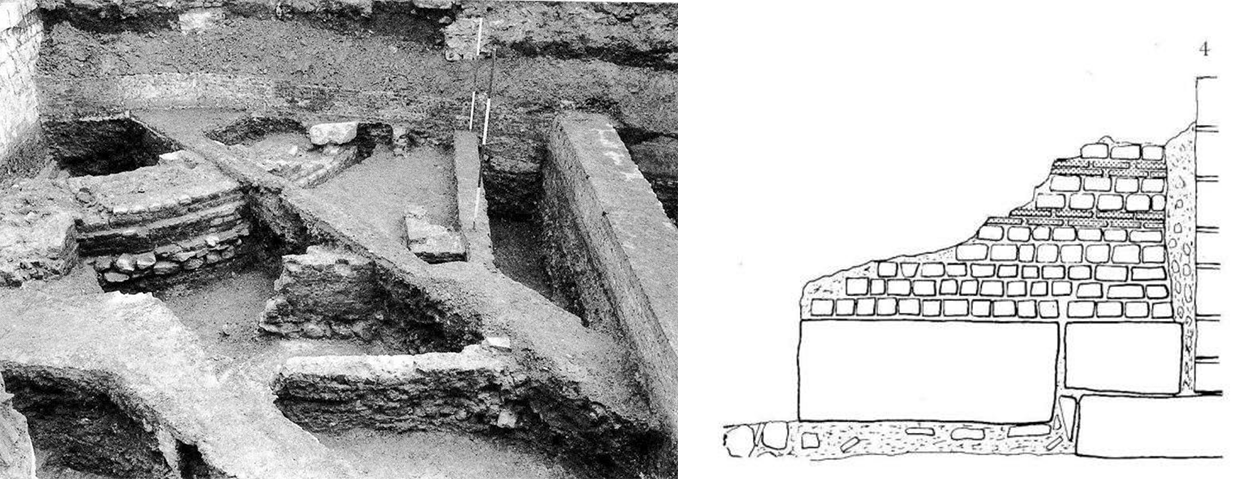
From excavations in 1910 (West Tower), 1921 (SW corner Tower), 1967 (North Tower) and 1982 (East Tower), four out of ten have been either partially or fully excavated and another one was discovered in 2010 using remote sensing techniques. Although this leaves a remaining five that have yet to be discovered, the relative locations of each of the known towers in each cardinal direction has allowed archaeologists to fill in the gaps with an educated, yet hypothetical, reconstruction of the missing towers and wall ramparts. While the towers have slight variations in their measurements, the outer diameter is about nine meters with a wall thickness of c. 1.40 to 1.70 meters.
In terms of construction, the towers are consistent with their adjoining walls — a slant on the field side of the walls and a stepped overhang on the interior side. However, the walls of the towers are built using the opus vittatum mixtum construction technique — meaning alternating layers of local blocks and single or multiple layers of brick tiles as facing for a concrete core. In the case of the tower walls at Maastricht, the two foundation layers are of large limestone blocks with the upper layers consisting of three to four layers of small Devonian sandstone mini-blocks interspersed with one to two layers of baked red clay tiles (Panhuysen, 1996). While there is no evidence for roofing on top of the towers, it is likely each tower would have been roofed with tiles as this would have been standard for fort construction for the region and period.