This guided presentation on the archaeological sources provides a structured overview of the late Roman castellum of Maastricht by reporting on the relationship between archaeological evidence, regional comparanda and the hypothetical 3D reconstruction developed for this project. Each of the reconstructed elements of the castellum is organised into three concise components: (a) a general description of the architectural or functional element under discussion; (b) a summary of the relevant archaeological findings; and (c) an account of the interpretive process through which excavated remains, historical sources and analogous sites were assessed to generate the 3D representation.
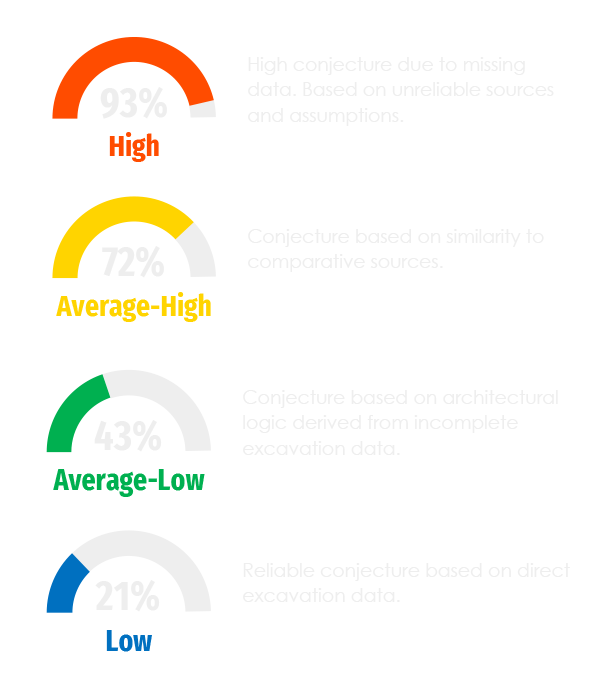
To support methodological transparency, this presentation employs a four level, colour‑coded uncertainty scale adapted from Apollonio et al. (2024) (see figure below). The scale is applied in the 3D environment to visually distinguish elements that are well supported by archaeological evidence (blue) from those that rely more heavily on comparative analysis (yellow and green) or pure hypothesis (red). Text descriptions for a more nuanced application of the scale is provided as a Nota Bena for each of the c-designated texts.
For a more detailed explanation of the source-based heritage visualisation process and its role in transparent communication of 3D research follow the tour on Creation Process.