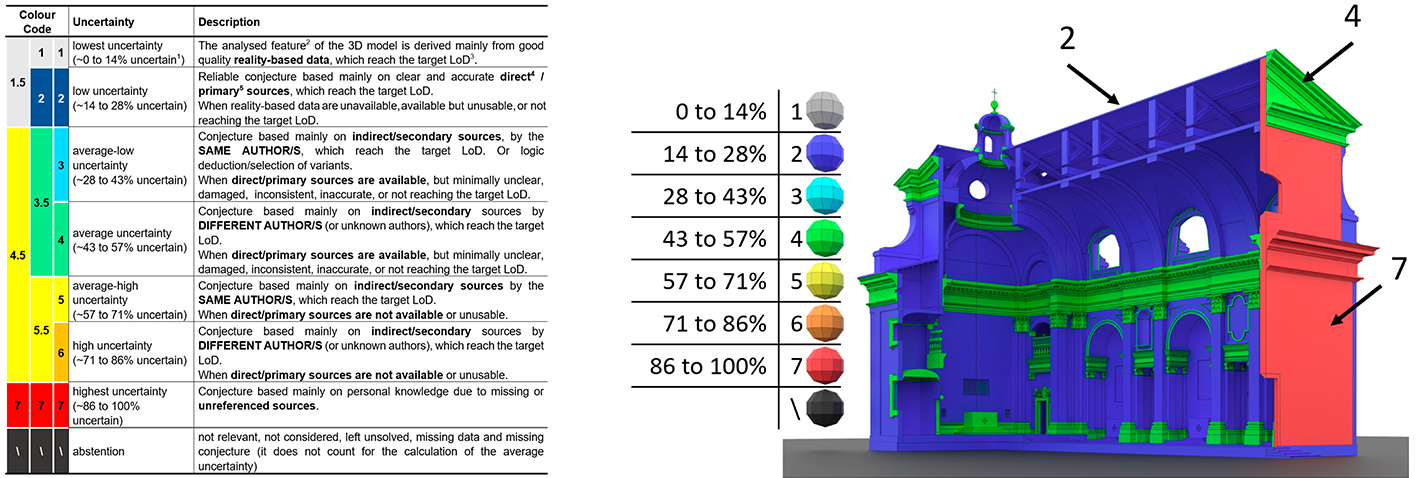
Questions and challenges regarding uncertainty and alternative hypotheses are inherent to source‑based 3D reconstruction. Uncertainty arises whenever the available evidence is incomplete, ambiguous or open to more than one plausible reading, while alternative hypotheses capture those different, evidence‑based options that could be modelled for a given feature (Münster et al., 2024). In the domain of digital heritage, several visual conventions have emerged to communicate these aspects to viewers. Colour‑coded uncertainty scales are often used to distinguish elements with strong archaeological support from those based on analogy or interpretation; realistic textures are reserved for well‑attested structures, while simplified or stylised textures signal more tentative reconstructions (Landes et al., 2019; Apollonio et al., 2021, Foschi et al., 2024). Degrees of transparency, ghosted geometry, wireframes and staged transitions between model states are also employed to indicate hypothetical possibilities rather than fixed facts.
This project adopts and adapts those conventions to make the interpretive status of each element legible at a glance. The remains documented through excavation and standing masonry are presented as simplified but solid forms, using a consistent colour scheme to indicate the relative certainty of their presence and position. These volumes do not aim for photorealism; instead, they emphasise the underlying archaeological presence while still distinguishing more secure features from those that are less well understood.
By contrast, aspects that are largely conjectural—above all the bridgehead on the eastern bank of the Meuse and the internal configuration of the fort—are shown in a neutral grey, with slightly transparent, untextured geometry. This visual treatment marks them as hypotheses about both existence and form. Within the Voyager presentation, alternative layouts for these conjectural areas are further explored through transitions between different model variants, inviting viewers to see multiple plausible configurations and to recognise that the reconstruction remains open, provisional and subject to future revision.